If you choose to target spawning bass, precise presentations are common—but release the fish quickly and near the capture site. Research documents individual nest effects from angling and displacement without proving that every bed-fishing event causes population decline. For the underlying seasonal biology, see When Do Largemouth Bass Spawn?.
Short answer
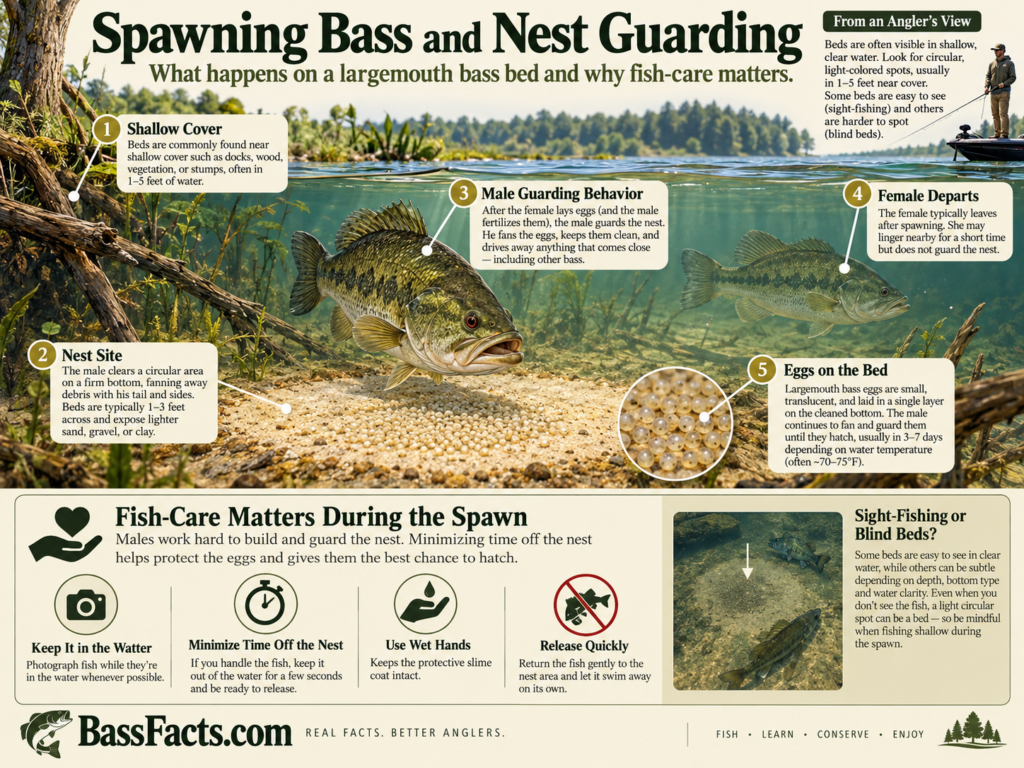
Spawning bass can be targeted either by sight—locating an actual nest and fish—or “blind” by fishing likely protected spawning cover when water clarity prevents seeing the bed. Soft plastics, jigs, drop-shots and other precise presentations are commonly used. If you choose to target nest-guarding bass, keep the fish close to the capture location and release it quickly; research shows prolonged removal and displacement can increase nest abandonment.
How anglers target spawning bass
First: know whether the fish are actually spawning
There is no universal temperature switch for the spawn. The dedicated spawn-biology guide covers the science in detail; on the water, several practical points matter:
- fish do not all spawn at once
- protected shallow habitat and suitable substrate matter
- water clarity/depth determines whether an angler can see beds
- waves of fish may be pre-spawn, spawning and post-spawn simultaneously in different parts of a lake
Sight fishing
Sight fishing means the angler sees the fish/bed and can watch its reaction.
Practical sequence:
- locate the bed before moving close
- stop well outside the fish’s comfort zone
- mark the exact bed/target visually
- approach from an angle that keeps sun/glare manageable
- cast beyond the bed when practical so the bait reaches the nest without splashing directly onto the fish
- watch the fish’s body language and bait—not simply the line
Common precise presentations include Texas-rigged soft plastics, compact craws, drop-shots, wacky/Neko-style worms and jigs.
Blind bed fishing
If water is stained or the bed cannot be seen, target places bass commonly select:
- isolated wood
- holes or edges in vegetation
- protected pockets
- hard spots
- dock corners/posts
- current breaks in tidal systems
Bassmaster anglers describe fan-casting soft plastics and working likely bed-sized zones slowly rather than trying to “see” every fish.
The conservation evidence
A 2012 study exposed nest-guarding male largemouth bass to:
- no angling
- catch-and-release angling
- simulated tournament angling involving longer removal/displacement
At 24 hours, abandonment was:
- 3% controls
- 33% catch-and-release
- 90% simulated tournament
The authors explicitly said more research was needed to determine population-level consequences.
A 2009 study likewise found prolonged removal/displacement consistently increased nest abandonment in largemouth and smallmouth bass.
Therefore the practical Bass Facts recommendation is:
- if targeting a nest fish, release it immediately
- release it at/near the capture site
- avoid unnecessary livewell retention/displacement
- minimize air exposure and handling
- do not claim that one quick catch automatically destroys a bass population
The ethics question is separate from the biological question
Some anglers choose not to bed fish even where it is allowed, while others consider it a legitimate seasonal technique. The evidence supports separating four questions:
- legality varies by jurisdiction/season/water
- individual nest effects from angling/removal are scientifically documented
- population-level outcomes depend on fishing pressure, predator communities, recruitment and management context
- personal sportsmanship preferences are not scientific findings
Regulations
Bed-fishing regulations are not universal. Black-bass seasons, harvest rules and waterbody-specific restrictions vary by jurisdiction, so anglers should check the current rules for the water they plan to fish.
In Texas, statewide largemouth-bass fishing is governed by current bag and length limits plus waterbody exceptions; the TPWD regulations link below is the better reference than freezing a regulation into evergreen article text.
Sources
- TPWD largemouth life history: https://tpwd.texas.gov/huntwild/wild/species/?o=lmb
- 2012 North American Journal of Fisheries Management nest-abandonment study: https://academic.oup.com/najfm/article/32/5/832/7827866
- 2009 Transactions AFS reproductive-success study: https://academic.oup.com/tafs/article/138/4/818/7887973
- Bassmaster 2025 conservation discussion: https://www.bassmaster.com/conservation-news/news/should-we-lose-sleep-over-bed-fishing-2/
- Bassmaster sight-fishing alternatives: https://www.bassmaster.com/how-to/news/sight-fishing-alternatives/
- Bassmaster blind bed baits: https://www.bassmaster.com/slideshow/blind-bed-fishing-baits/
- TPWD 2026–27 general/freshwater regulations: https://tpwd.texas.gov/regulations/outdoor-annual/fishing/freshwater-fishing/freshwater-fishing-landing-page