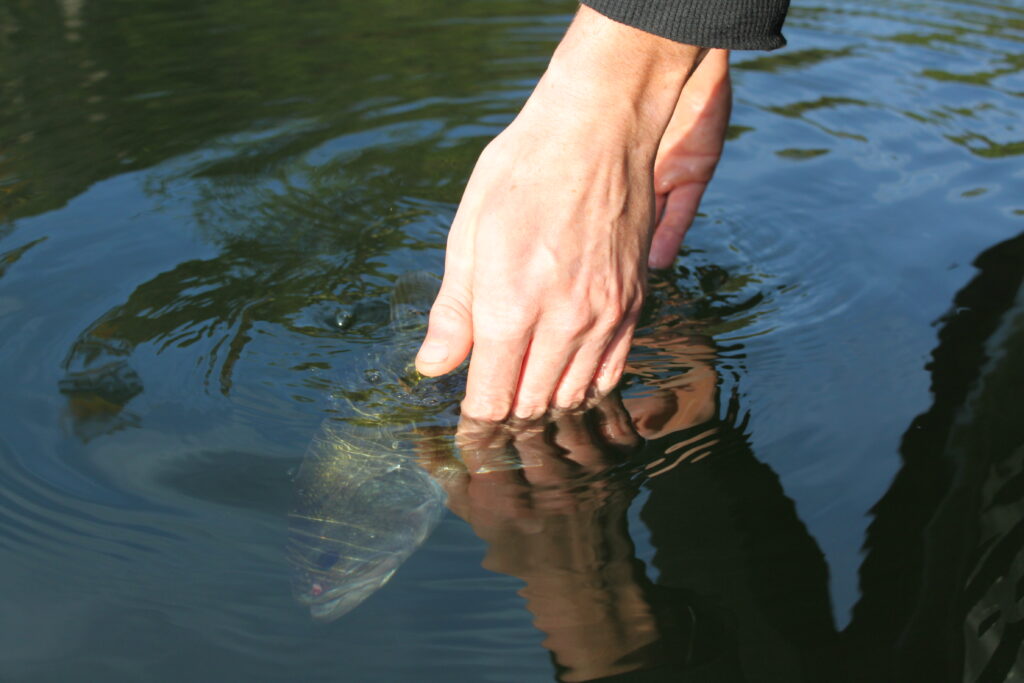
Land the bass efficiently, leave it in the water while you get ready, wet your hands, avoid the gills and eyes, support large fish horizontally with a second hand under the body, take the photo quickly, and return the fish to the water as soon as practical.
A simple four-step routine
Have pliers, scale, measuring board and camera ready before lifting the fish.
Leave the bass in the water when practical; use wet hands and a rubber-mesh net if needed.
For a large bass, one hand controls the lower jaw while the other supports the body.
Make the out-of-water portion brief and return the fish gently.
How long can a bass safely stay out of water?
There is no scientifically established universal “30-second rule” for largemouth bass. The better evidence-based advice is to minimize air exposure rather than claim a magic cutoff.
In one controlled study at moderate water temperatures, bass exposed to air for roughly 10 minutes or more showed higher blood-glucose responses and took longer to regain equilibrium than fish exposed for roughly three minutes or less. No mortality occurred during the five-day monitoring period, but the longer exposures produced measurable physiological and behavioral effects.
Those experimental exposure times are much longer than a normal catch photo should take. They show why “it swam away” is not the only measure of handling stress.
Should you hold a bass vertically or horizontally?
Texas Parks & Wildlife currently says fish under about five pounds can be held vertically by the lower jaw, while larger fish should be held horizontally and supported with two hands. For trophy fish, that is the safest default for both control and body support.
A 2017 experiment compared three handling treatments in Florida largemouth bass: a vertical lip-grip hold, a tilted one-handed jaw hold, and a two-handed supported hold. Fish recovered equilibrium fastest after the supported treatment—an average of about 7 seconds, compared with 12 seconds after the tilted one-hand hold and 33 seconds after the vertical lip-grip treatment.
Importantly, the study did not find treatment-specific differences in feeding, jaw adjustments or mortality. So the often-repeated claim that one brief bad angle automatically “breaks a bass’s jaw” goes further than that experiment supports. The researchers nevertheless recommended two-hand support because recovery was fastest.
What about the famous one-hand sideways bass pose?
A one-handed tilted hold places the fish’s body weight away from the point where the jaw is being controlled. Especially with a large fish, there is little reason to add that leverage when a second hand can support the body. Bass Facts recommends the supported horizontal pose for large bass.
Protect the slime coat
Fish mucus is part of the protective barrier against pathogens and physical damage. Agency guidance consistently recommends wet hands, keeping fish off dry carpet and boat decks, and using smooth or rubberized surfaces when contact is unavoidable.
What if the fish seems exhausted?
Support the bass upright in the water and allow it to regain equilibrium. TPWD recommends gently facing or moving an exhausted fish so water passes through the mouth and over the gills. Do not throw or drop a sluggish fish back into the water.
Catch-and-release checklist
- Land the fish without unnecessarily exhausting it.
- Keep pliers and hook-removal tools within reach.
- Wet your hands before touching the fish.
- Avoid fingers in the eyes or gills.
- Use a rubber-mesh net if a net is needed.
- Keep large bass supported with two hands.
- Wet the measuring board before laying a fish on it.
- Keep air exposure as short as practical.
- Release gently after the fish regains balance.
Primary & authoritative sources
TPWD
Study
Study
TPWD