Largemouth bass can distinguish colors. That does not establish a universal favorite lure color: detecting a target, learning to recognize it, and choosing to strike are different questions.
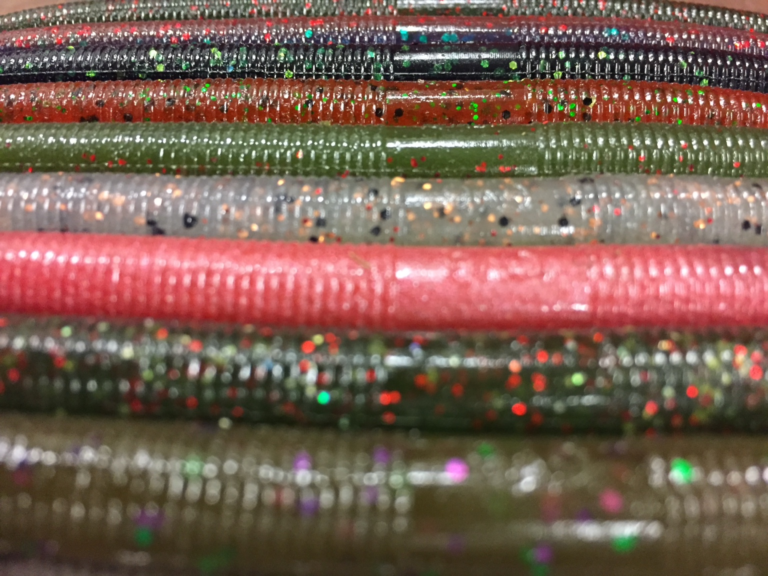
What the experiments actually tested
A 2002 retinal study provided physiological evidence of color vision and described an eye suited to perceiving form and movement. It was a study of vision, not a ranking of lure finishes. [2]
Mitchem and colleagues combined photoreceptor measurements, a visual model and food-reward training. Their results supported dichromatic color vision, with two cone classes. Bass trained to red or green distinguished those targets from the alternatives tested; some other color pairs were harder to separate. The article appeared online in 2018 and in the February 2019 issue of Current Zoology. [1]
The trained-fish experiment tested discrimination; it did not establish that wild bass prefer red lures across seasons, habitats and presentations. Nor does difficulty distinguishing a blue target from a dark one mean that a blue lure is invisible. These are limits on what we can infer from the experiment. [1]
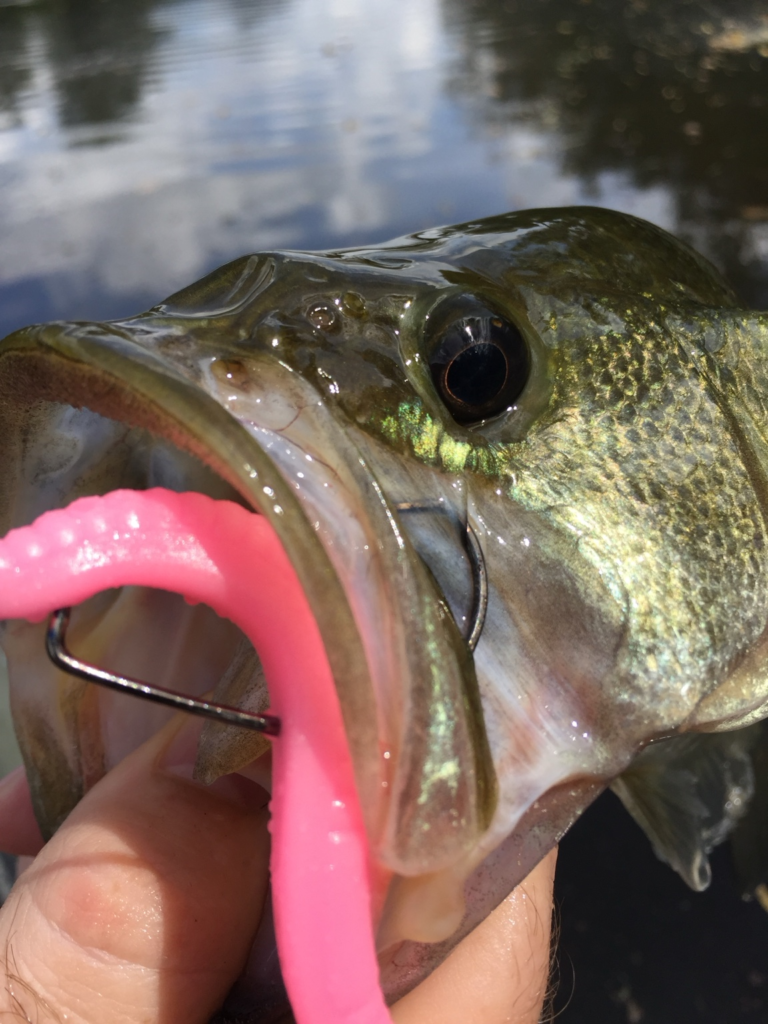
Use the research without inventing a color rule
Our practical interpretation is to treat color as one part of presentation. Begin with a lure you can put at the fish’s depth and retrieve through its likely feeding area. Then compare finishes while holding the lure’s size, action and retrieve as steady as possible. This is an angling decision framework, not a catch-rate prediction from the laboratory.
| Claim | Useful evidence | Common mistake |
|---|---|---|
| Bass distinguish two colors | A controlled discrimination test | Calling the better-recognized color a favorite |
| A finish catches more fish | Repeated comparisons with comparable fishing effort and presentations | Comparing one productive day with one poor day |
| A color works in this lake | A local pattern with conditions recorded | Turning that pattern into a rule for every lake |
A better way to compare your own results
Write down which color you actually fished, for how long, at what depth and with which retrieve. If you spend nearly the entire morning with one finish, its higher catch count says little about the finishes left in the box. A follow, missed strike and landed fish are also different observations; record them separately.
Change one variable when practical. Swapping a small silent bait for a larger rattling bait in another color cannot isolate a color effect. Alternate the order of your comparisons on later trips, and retain the blank trips as well as the memorable catches. These notes will not turn casual fishing into a controlled experiment, but they make your own claims easier to assess.
Two useful distinctions
Fish color versus fish vision
A golden, pale or blotchy bass raises a pigmentation question. What that fish can see is a sensory question. Our unusual-coloration reference covers the former; this page covers the latter.
A model versus a photograph through a bass’s eyes
Any illustration claiming to show exactly how a bass sees a lure needs explicit assumptions and a validated model. We do not present human-visible color swatches as a literal bass-eye view.
Sources and scope
- Mitchem et al. — Seeing red: color vision in the largemouth bass. Current Zoology 65(1), 43–52; DOI 10.1093/cz/zoy019. Physiological measurements, modeling and behavioral discrimination.
- Kawamura & Kishimoto — Color vision, accommodation and visual acuity in the largemouth bass. Fisheries Science 68(5), 1041–1046 (2002). Retinal and anatomical evidence.
The fishing comparison framework is Bass Facts editorial guidance. Neither paper supplies a universal lure-color leaderboard. Sources checked September 8, 2026.