The oldest largemouth bass reported in the peer-reviewed fisheries literature was aged at 23 years from otolith annuli; the authors noted that another annulus may have been present at the edge. That record does not mean most bass live anywhere near 23 years. Longevity, growth and survival vary among populations, and the age of an individual fish generally cannot be determined from length or weight alone.
What is the oldest documented largemouth bass?
A 1994 paper by David M. Green and Roy C. Heidinger reported a largemouth bass whose age was estimated at 23 years from the number of annuli on an otolith. The authors wrote that an additional annulus could have been present at the edge of the otolith. Before that report, the maximum published age they cited was 18 years.
That makes 23 years a useful documented longevity benchmark, but it should not be converted into a claim that largemouth bass normally live 20-plus years. A maximum observed age describes an exceptional fish, not the average age reached in a population.
How do fisheries biologists determine a bass’s age?
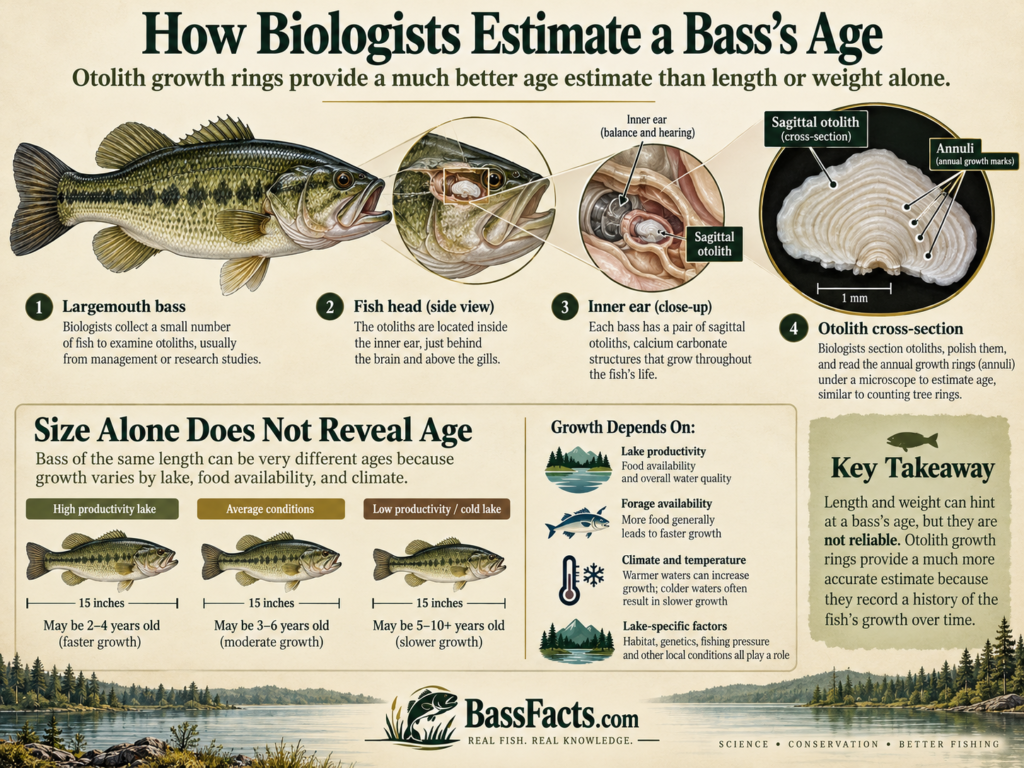
Fish do not have birthdays written into their scales. Biologists estimate age by interpreting growth marks on hard structures. For largemouth bass, sagittal otoliths—calcified structures in the inner ear—are generally the preferred aging structure because they tend to produce more accurate and precise estimates than scales.
A 2003 validation study used known-age largemouth bass from age 0 through age 16 and found the otolith ages were correct for 97% of the fish. That work is important because it showed that properly prepared otoliths can remain useful well beyond young fish.
Why scales can give the wrong age
Scales are attractive because they can be collected without killing the fish, but they can introduce age bias. A 2017 comparison found scale-derived ages tended to overestimate younger largemouth bass and underestimate older fish relative to otolith-derived ages. A 2024 study in Arizona reservoirs likewise found scales less precise and biased compared with otoliths.
Older work in Florida also showed why preparation matters. By age 5, some whole otoliths obscured annuli and underestimated true age; sectioned otoliths were more reliable.
| Aging structure | Advantage | Main limitation |
|---|---|---|
| Sectioned sagittal otolith | High accuracy and precision when properly prepared and read | Collection is generally lethal |
| Whole otolith | Faster to process | Growth marks can become difficult to interpret as fish age |
| Scale | Nonlethal and easy to collect | Can bias ages, especially for older fish |
| Fin spine | Potential nonlethal alternative | Studies have found lower agreement with known ages than otoliths |
Can you tell a bass’s age from its size?
Not reliably. Two largemouth bass of the same age can be very different sizes because growth changes with growing-season length, forage, bass density, habitat, genetics and other local conditions. Conversely, two bass of similar length may be different ages.
That is why questions such as “How old is a 5-pound bass?” or “How old is a 20-inch bass?” do not have one defensible answer. Local length-at-age information can give context, but an individual fish’s actual age requires an aging structure or a known history such as tagging or hatchery records. See How Fast Do Largemouth Bass Grow? for regional growth examples.
Does a trophy bass have to be extremely old?
Not necessarily. Trophy size reflects both age and growth rate. A fish with exceptional forage and a long growing season may reach a large size relatively quickly, while an older fish in a slower-growing population may remain much smaller. Weight also changes with body condition, season and reproductive state, so weight is an especially poor stand-alone age estimator.
Longevity is not the same as average lifespan
Maximum age, average age in a sample and life expectancy are different measurements. Fisheries surveys are also selective: gear, season, habitat and harvest can influence which ages are represented. Bass Facts therefore treats the 23-year value as a documented maximum-age observation rather than a universal lifespan figure.