The largemouth bass is a North American black bass now recognized as Micropterus nigricans. It is a warm-water predatory sunfish found in lakes, reservoirs, ponds and rivers, and has been introduced widely outside its native range because of its popularity as a sport fish.
 12345678910
Why you may remember a different scientific name
For decades, anglers and fisheries literature commonly used Micropterus salmoides for largemouth bass and treated Florida bass as a subspecies. A 2022 phylogenomic study separated the two as distinct species and concluded that M. salmoides properly belongs to Florida bass, while M. nigricans is the valid name for largemouth bass.
How to identify a largemouth bass
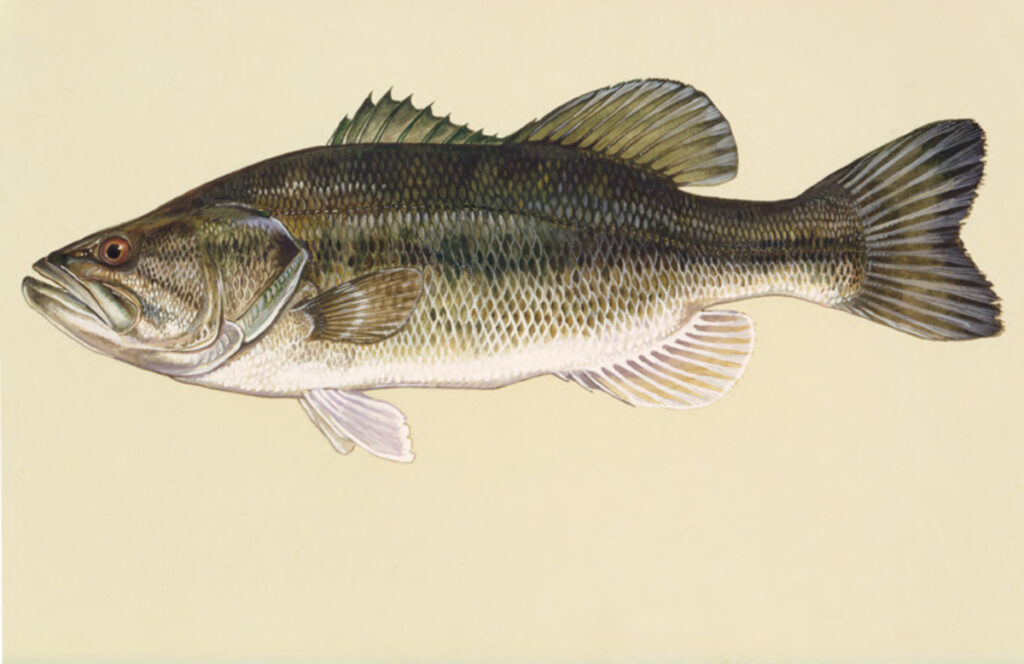
Adult largemouth bass have the oversized mouth that gives the species its common name. The upper jaw extends behind the rear margin of the eye, and the body commonly carries a dark horizontal band that is often broken into irregular blotches. Body color varies with habitat and water conditions, from silvery or pale green to darker olive or brownish tones.
Where largemouth bass live
Largemouth bass occupy a remarkably wide range of freshwater habitats, including reservoirs, natural lakes, ponds, swamps, river backwaters and slower river reaches. USGS describes them as particularly abundant in warm, productive systems with vegetation and submerged structure such as logs, rocks and aquatic plants.
The species has also been intentionally stocked far outside its native range for recreational fishing. That success has a second side: in some places, introduced largemouth bass have become invasive predators that affect native fish communities.
What largemouth bass eat
Largemouth bass are opportunistic predators. Adults are strongly piscivorous, but their diet can also include crayfish and other animals they can capture and swallow. Vision is important during feeding, but bass also use other sensory systems, including the lateral line.
Their feeding behavior is not simply “open mouth, inhale prey.” Largemouth bass combine forward motion with rapid expansion of the mouth and throat, generating suction that pulls water—and prey—toward the mouth. Bass Facts treats that biomechanics topic separately in our prey-capture guide.
Largemouth bass versus Florida bass
The 2022 genomic revision recognized largemouth bass and Florida bass as separate species. The distinction is especially important because the two can be difficult or impossible to separate reliably by appearance alone in some regions, particularly where stocking and hybridization have mixed their genetics.
This taxonomic change is now affecting fishing records, hatchery programs and fisheries management. IGFA currently groups the two together for many record categories as “largemouth bass (M. nigricans/salmoides)” while requiring genetic verification for new All-Tackle record claims.
Bass Fishing Glossary
A searchable reference for the fishing and habitat terms used throughout Bass Facts.
Primary & authoritative sources
Read the study
USGS species profile
IGFA explanation