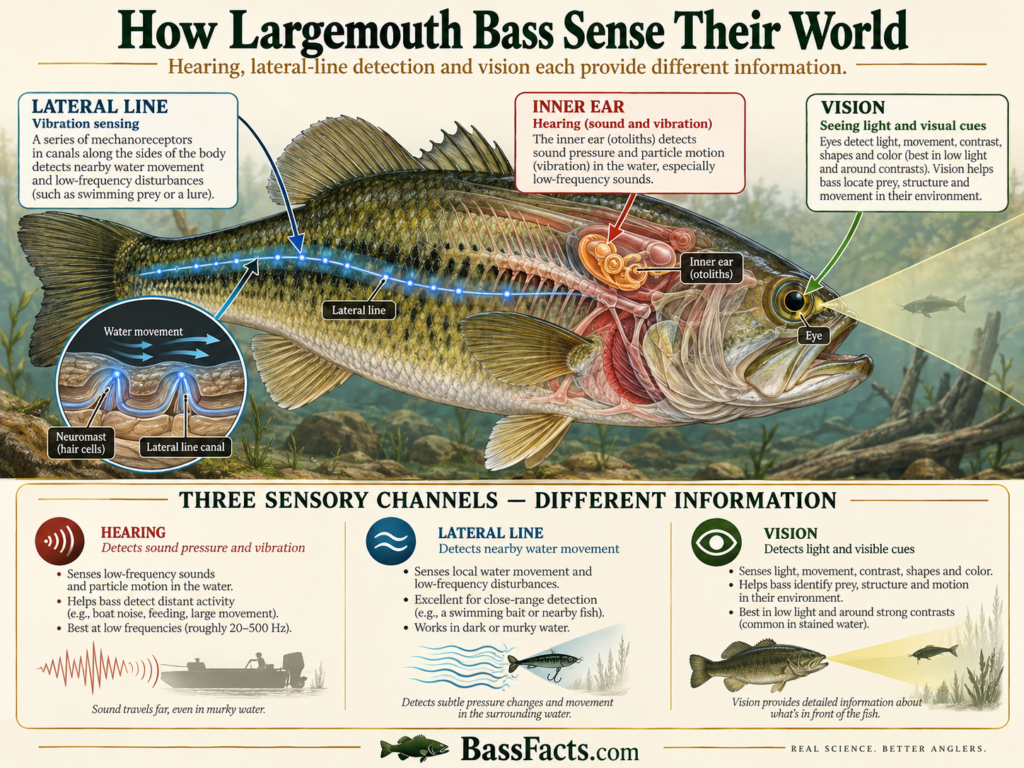
Yes, largemouth bass can detect underwater sound. They also have a lateral-line system that detects local water movement. Those systems overlap in the information they provide, but they are not interchangeable: the inner ear is an auditory and balance organ, while the lateral line is a mechanosensory system especially useful for nearby flow and movement cues.
Do bass have ears?
Yes, but not external ears like a mammal. The auditory organs are inside the head. Fish can respond to the particle-motion component of underwater sound through the inner ear. Largemouth bass do not have the specialized Weberian ossicles that make some groups of freshwater fish especially sensitive to sound pressure, so it is more accurate to describe them as fishes without specialized auditory enhancement rather than as “deaf” or “super-hearing.”
What does the lateral line actually detect?
The lateral line is a mechanosensory system made of neuromasts located in canals and on the body surface. These receptors respond to local water motion and pressure gradients created by moving objects, prey, the fish itself and surrounding flow.
That makes the lateral line particularly useful at close range and when visibility is poor. It does not function as a second ear in the simple sense often used in fishing discussions.
Can largemouth bass feed without seeing?
Laboratory work shows that they can. In a 2012 study, largemouth bass capturing live mosquitofish changed their feeding behavior when visual or lateral-line information was experimentally removed. Earlier work cited by the authors had shown that blind bass could still strike accurately using lateral-line information, while removing both visual and lateral-line information could stop feeding.
The useful conclusion is not that vision is unimportant. It is that largemouth bass integrate multiple sensory channels and can shift how they capture prey when one source of information disappears.
Is a lure’s vibration the same thing as sound?
No. A moving lure can create several physical cues at once: water displacement, local flow, substrate contact and acoustic energy. The lateral line is most relevant to nearby hydrodynamic disturbance, while the inner ear is involved in acoustic detection. An angler may call all of those cues “vibration,” but that word combines different physical phenomena and different sensory pathways.
What does this mean for rattles, blades and noisy lures?
Research confirms that largemouth bass can detect mechanical and acoustic information, but it does not justify a universal rule that louder lures are better, that a particular rattle can be detected at a specific fishing distance, or that one frequency always triggers strikes. Those angling claims depend on conditions, lure design, background noise and fish behavior and require direct testing rather than inference from sensory anatomy alone.
Can underwater noise affect bass?
Experimental studies show that some kinds of sustained underwater noise can alter largemouth-bass behavior or physiology. A 2021 recirculating-aquaculture study found changes in growth, physiological measures and schooling behavior under chronic equipment noise. A 2024 follow-up reported stronger effects from low-frequency industrial noise than higher-frequency noise in that artificial system.
Those experiments are useful evidence that bass perceive underwater noise, but they should not be translated directly into claims about ordinary boat noise, lure sound or wild-fish catch rates. The sound levels, duration and captive setting are different.
What anglers can take from the science
- Bass do not rely on vision alone.
- The lateral line is especially important for nearby water-motion cues.
- Hearing and lateral-line sensing are distinct.
- “More noise” is not automatically “more attractive.”
- Claims about lure sound should be separated from what sensory studies actually tested.