Largemouth bass use a combination of ram feeding and suction. They accelerate toward prey while rapidly expanding the mouth and buccal cavity. That expansion lowers pressure and creates an inward flow of water that helps pull prey through the mouth opening.

The strike in four steps
The bass positions itself and accelerates toward the prey.
The jaws open while the skull and throat begin expanding.
Expansion drops pressure and drives water into the mouth, carrying prey with it.
The bass decelerates, uses fins and body movements, and completes capture.
Why suction matters
Suction-feeding fishes create a flow field outside the mouth. In largemouth bass, fast expansion of the oral cavity generates subambient pressure. Experiments have shown that faster mouth opening and hyoid depression are linked with stronger pressure changes during a strike.
But suction is only part of the attack. Largemouth bass also move aggressively toward their prey. Comparative work with bluegill found that largemouth bass tended to close distance faster and ingest a larger volume of water, illustrating their relatively strong “ram” component.
The body muscles help power the mouth
One of the more surprising discoveries from bass biomechanics is that suction feeding is powered substantially by the same large axial muscles used for swimming. A 2015 study found that these muscles contribute most of the power needed for cranial expansion during feeding. In other words, the explosive strike is not powered only by small jaw muscles.
What changes when bass feed in current?
The newest piece of the story was formally published September 1, 2026, in Ecological and Evolutionary Physiology. Researchers placed largemouth bass in a flume and recorded prey-capture strikes under flow speeds from 0 to 60 cm/s using high-speed video.
As current increased, bass altered several parts of the strike rather than using one fixed feeding program. The researchers reported changes that included faster swimming during the attack, greater mouth expansion and altered use of the pectoral fins during braking.
That matters because many classic feeding experiments use still water. Real bass routinely feed in current—from rivers and tailraces to wind-driven flow, culverts and moving-water edges. The new study shows that prey-capture mechanics are flexible enough to respond to that environment.
What determines how much suction a bass produces?
- How quickly the mouth and throat expand.
- How large the gape becomes.
- The coordination of jaw, hyoid and cranial movements.
- The distance and orientation of the prey.
- How much the bass uses forward body motion versus suction.
Studies also show that “suction distance” alone is a poor measure of performance because water velocity falls rapidly with distance from the mouth and prey behavior matters.
Do largemouth bass have teeth in their throat?
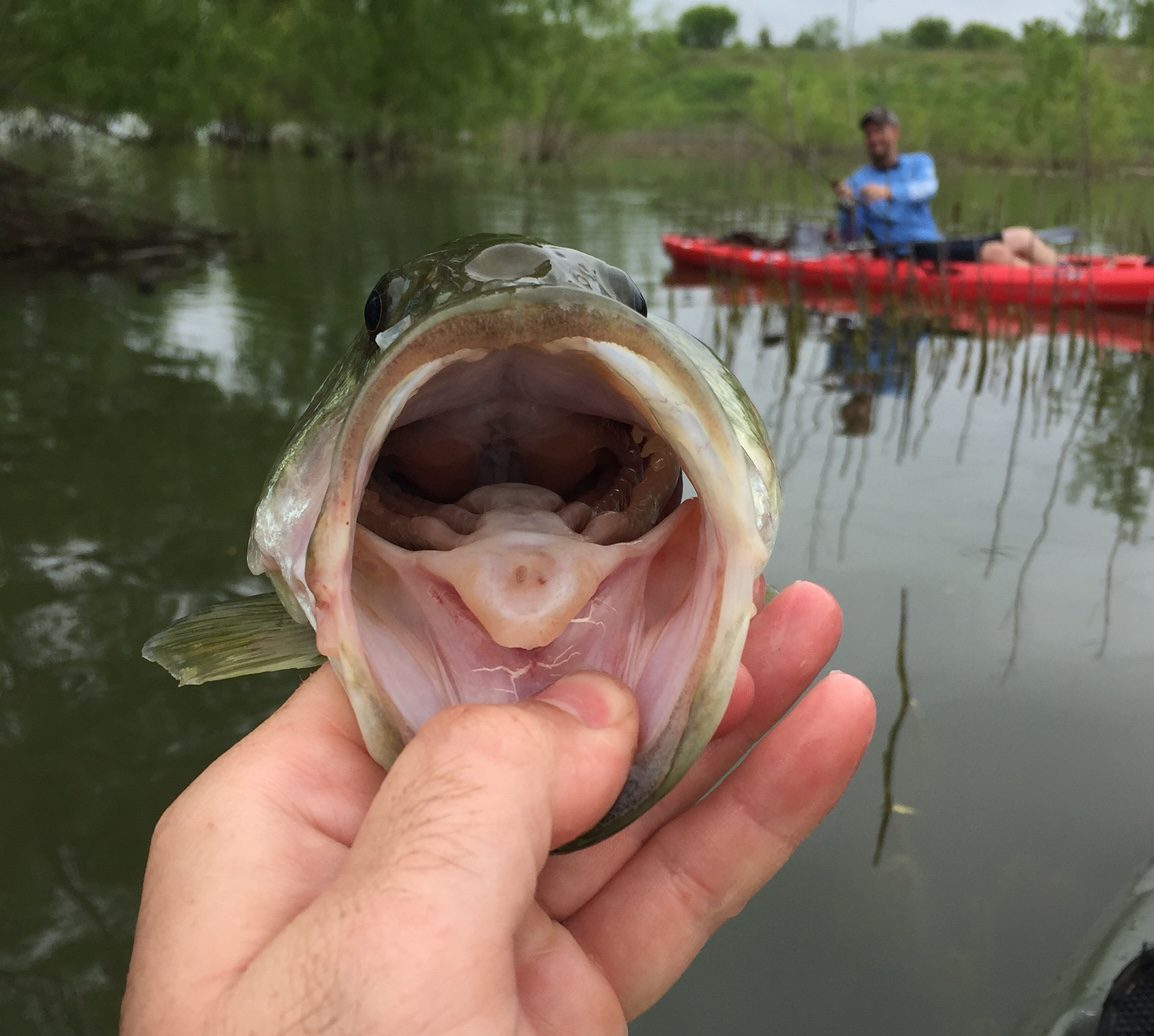
Capture is not the end of feeding. Farther back in the throat, largemouth bass have pharyngeal jaws with small teeth that help grip and process prey before it is swallowed. These are separate from the visible teeth lining the mouth.
Primary sources & further reading
Read publication page
Read full paper
PubMed
PubMed