Facts • Reference
Bass Fishing Glossary
A searchable guide to the rigs, lures, electronics, habitat terms and angler shorthand used in bass fishing—with a few commonly confused definitions cleaned up.
A searchable guide to the rigs, lures, electronics, habitat terms and angler shorthand used in bass fishing—with a few commonly confused definitions cleaned up.
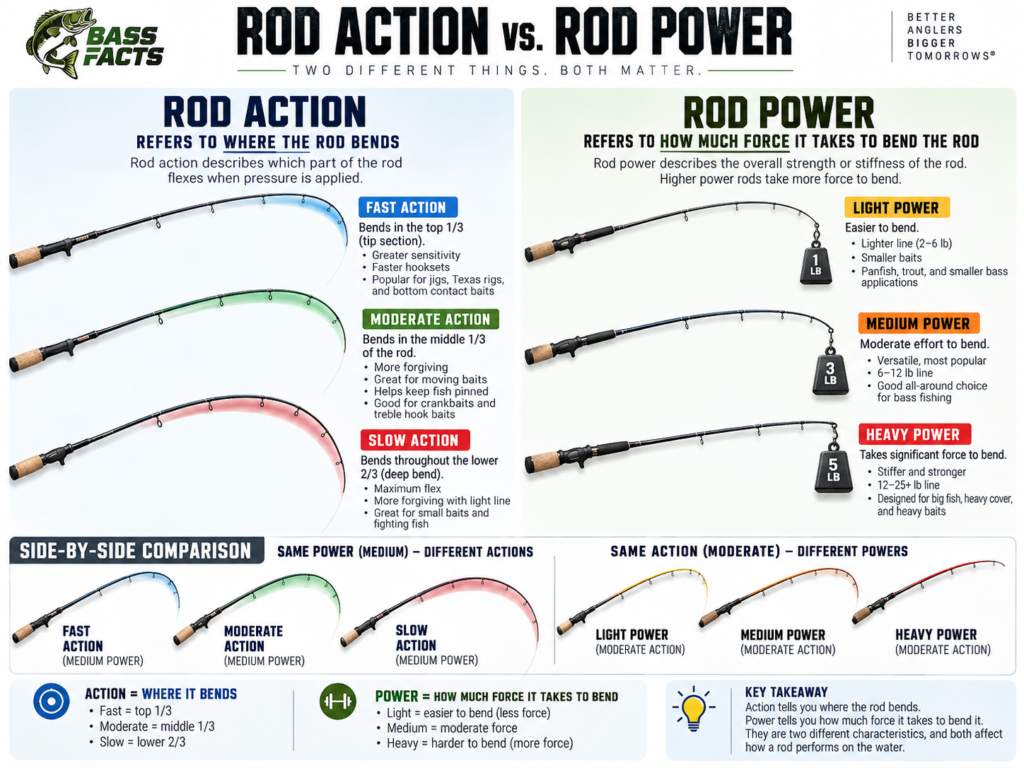
Where along a fishing rod the blank bends under load. A fast-action rod bends mostly near the tip; a moderate or slow action bends progressively farther down the blank.
Fish that are feeding, moving or otherwise relatively willing to strike compared with inactive fish.
A multi-arm umbrella-style rig that presents several swimbaits or teasers at once. Hook-count rules vary by jurisdiction.
A person who fishes, usually with rod and reel.
A reel mechanism that prevents the handle and rotor/spool system from turning backward when engaged.
A tangle in a baitcasting reel caused when the spool rotates faster than line is leaving the reel; often called a bird’s nest.
A slow-current or nearly isolated area connected to a river, creek or reservoir arm, often shallow and protected.
The maximum number of fish an angler may legally retain during a specified period. Exact limits vary by species and jurisdiction.
A nest or spawning site prepared and guarded by a male bass during reproduction.
Angler shorthand for bright, clear, cloudless conditions. Claims that these conditions always make bass difficult are an angling generalization, not a biological rule.
A concentration of submerged limbs, branches or woody debris that provides fish habitat and ambush cover.
A wire-frame topwater lure whose rotating blade churns the surface during retrieve.
A bottom-contact soft-plastic rig in which a sliding sinker is separated from the hook by a swivel and leader.
A follow-up lure cast quickly to a fish that struck or followed another bait but did not get hooked.
A productive, well-known fishing spot that receives substantial angling pressure.
Objects such as vegetation, stumps, timber, docks or rock piles that provide concealment or ambush habitat. In bass-fishing terminology, cover is distinct from bottom structure.
A hard-bodied lure designed to swim or wobble during retrieve. Many have a diving bill; lipless crankbaits use body shape and line attachment rather than a diving lip.
A soft-plastic lure with multiple appendages that loosely imitates a crayfish, insect, amphibian or other prey rather than one exact species.
Replacing a smaller fish in a legal tournament limit with a larger fish, subject to the event’s and jurisdiction’s rules.
Allowing a lure or bait to remain nearly motionless for an extended period.
A general term for sonar used to display water depth and underwater returns. Modern units may integrate mapping, side imaging, down imaging and live sonar.
Switching to smaller lures, lighter line or subtler tackle/presentations.
The adjustable reel system that allows line to slip under tension, helping manage sudden runs and reduce break-offs.
A rig with the hook tied above a weight at the end of the line, commonly used with a small soft-plastic bait.
Casting repeatedly at progressively different angles to cover a semicircle or broad area.
A broad category of relatively subtle presentations, often involving smaller lures, lighter line or slower movements.
An electronic sonar display used to interpret depth, bottom, structure, cover, baitfish and fish targets; many modern units also incorporate GPS/mapping.
A short-range presentation technique using a fixed amount of line to swing a bait quietly and precisely into nearby cover.
Live sonar oriented ahead of the boat, allowing an angler to watch fish, structure and often the lure update in near real time.
A fish species pursued recreationally for sport. Legal definitions can vary by state or country.
Slang for an unusually large bass.
A consistently productive fishing location, often one an angler prefers not to disclose.
The movement used to drive or seat a hook after a strike, adjusted to the hook style, lure and tackle.
An elongated minnow-shaped lure commonly worked with rod-tip twitches or jerks and pauses; models may float, suspend or sink.
A lure built around a weighted hook, often paired with a skirt and/or soft-plastic trailer.
A small, generally flat-bottomed utility boat widely used on shallow or protected waters.
A fallen tree that extends from the bank into the water.
Holding a bass by grasping the lower jaw. Large fish should also be supported horizontally rather than left hanging from the jaw.
An onboard tank designed to hold fish alive, commonly using aeration and/or recirculated water.
A large fish; exact thresholds vary by program and context.
Choosing lure size, profile, color or behavior to resemble prey fish are currently using.
A soft-plastic finesse rig with a weight inserted into one end and the hook placed through the body, causing the bait to stand or fall nose-down.
A controlled underhand presentation that sends a bait farther than traditional flipping while maintaining a relatively low, quiet trajectory.
A soft-plastic worm-shaped lure available in many lengths, body shapes and formulations.
The period after spawning when adult bass transition away from nesting activity and into subsequent seasonal patterns.
A line-strength rating expressed as the approximate breaking strength in pounds under standardized or manufacturer testing; actual performance varies by knot, wear and conditions.
Fishing or scouting before a tournament to learn the water and develop a plan, subject to event-specific off-limits and practice rules.
The period before spawning when bass move through seasonal staging areas toward spawning habitat.
Using a compact bait with a relatively heavy sinker to penetrate dense vegetation or surface mats.
A strike anglers attribute to sudden lure movement, proximity or surprise rather than sustained feeding behavior. The phrase is useful shorthand but does not identify a specific proven neurological mechanism.
A standardized fish-condition index comparing a fish’s observed weight with a species-specific standard weight for that length.
A forceful retrieve motion that moves a lure sharply, often followed by slack, a pause or a fall.
Fish grouping together; in bass fishing, the term often refers to bass collectively attacking concentrated baitfish.
A common name for several clupeid forage fishes, including threadfin and gizzard shad, important prey in many bass fisheries.
Sonar designed to display returns to the sides of a boat, useful for finding structure, cover and fish over broad areas.
Targeting fish that the angler can see, including but not limited to bass on spawning beds.
Retrieving a moving bait slowly enough to keep it at a selected depth while maintaining the lure’s intended action.
A wire-frame lure with one or more rotating blades and a weighted hook, usually dressed with a skirt or trailer.
A metal or metal-like lure that flashes and wobbles; bass anglers may cast, vertically jig or flutter spoons.
Minn Kota’s trademarked GPS boat-positioning function. Anglers often use the term generically, but GPS anchoring is the broader category.
Topographic features of the lake or river bottom—such as points, flats, channels, humps and drop-offs. In bass-fishing usage, structure is distinct from cover.
Describes a lure designed to remain near a selected depth when paused rather than quickly floating or sinking.
A soft-plastic rig in which the hook point is commonly buried or skin-hooked in the bait for a relatively weed-resistant presentation, often paired with a sliding bullet sinker.
The layer or depth zone where water temperature changes most rapidly with increasing depth. In stratified lakes it separates warmer upper water from cooler deeper water.
A lure designed to be worked on or immediately at the water surface.
A soft plastic or other component added to a jig, spinnerbait or similar lure. A trailer hook is a separate additional hook used on some baits where legal.
A soft-plastic presentation in which the hook is placed near the middle of the bait so both ends can move freely.
A rhythmic surface retrieve that makes a topwater lure swing side to side in a zig-zag pattern.
The vertical body of water from surface to bottom at a given location; anglers use the term when discussing depth zones.
A wire, fiber or plastic guard intended to reduce snagging by deflecting vegetation or cover away from the hook point.
Reviewed: September 28, 2026
Most lure, rig and technique definitions reflect standard bass-fishing usage. For terms where precision matters, Bass Facts uses external references: B.A.S.S. distinguishes structure from cover; NOAA defines a thermocline as the transition/rapid-temperature-change layer; and industry rod guidance consistently distinguishes action from power.
Regulatory terms such as bag limit and hook-count restrictions should always be checked against the jurisdiction being fished. Related references: the largemouth bass species profile, Choosing Bass Lures and the 50-state record database.