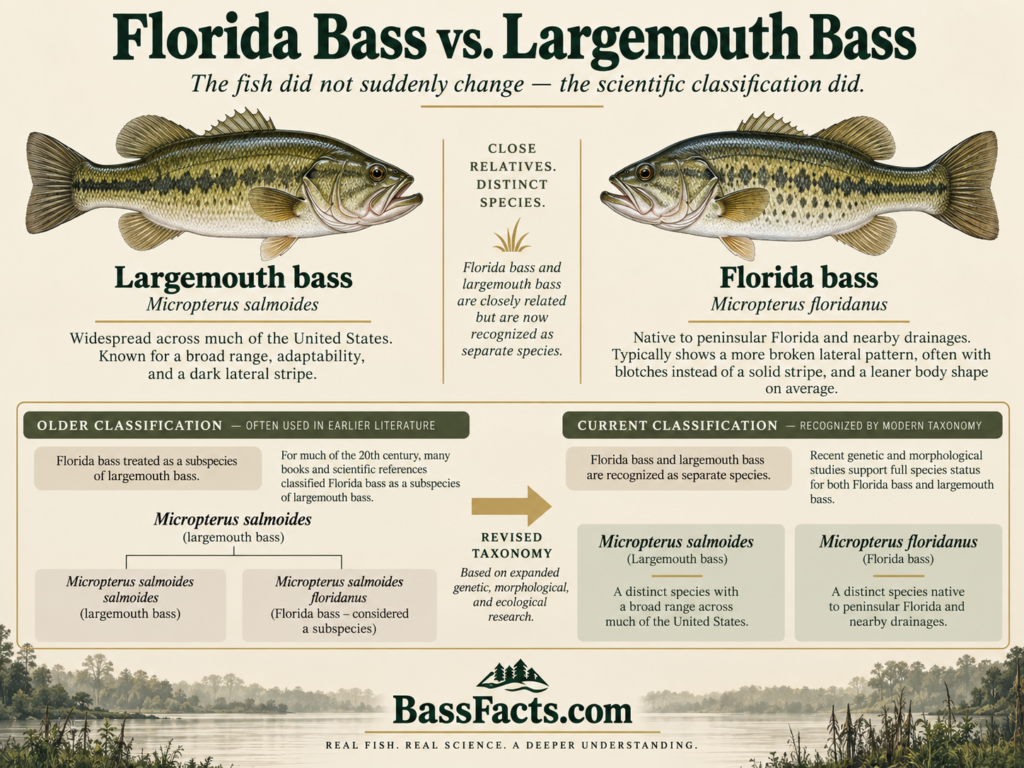
A large phylogenomic study published in 2022 supported Florida bass and largemouth bass as separate evolutionary lineages deserving species status. Because the original type material behind the name Micropterus salmoides belongs with the Florida-bass lineage, that familiar scientific name stayed with Florida bass. The older available name Micropterus nigricans was restored for largemouth bass. Record organizations and agencies have since begun adopting the change, although older literature and some agency pages still use the former subspecies terminology.
What changed?
In 2022, researchers used genome-scale ddRAD data and broad geographic sampling to re-examine species boundaries across the black bass genus Micropterus. Their analysis recovered two distinct lineages in the traditional largemouth-bass complex corresponding to what anglers had long called largemouth bass and Florida largemouth bass.
The authors treated those lineages as separate species. The nomenclature is unusually confusing because the name most anglers knew as “largemouth bass”—Micropterus salmoides—is tied to type-locality material that falls inside the Florida-bass lineage. As a result, M. salmoides applies to Florida bass and the older available name M. nigricans applies to largemouth bass.
So was “Florida-strain largemouth bass” wrong?
Not in its historical context. For decades the prevailing classification treated Florida bass as Micropterus salmoides floridanus, a subspecies of largemouth bass. Fisheries programs, hatchery records and thousands of scientific papers therefore use terms such as “Florida largemouth,” “Florida strain” and “northern largemouth.” Those sources do not become useless because nomenclature changed.
Bass Facts preserves historical wording when describing older programs, but uses the newer species names when discussing current taxonomy. Where a source itself uses legacy terminology, we make that context clear rather than silently rewriting the source.
Can you identify Florida bass by looking at one?
Not reliably enough for every management or record decision. Traditional meristic traits such as scale counts can differ on average, but the lineages hybridize where they meet naturally or where Florida fish have been stocked. IGFA specifically noted that Florida and largemouth bass can be difficult to distinguish without genetics.
That matters because decades of stocking have created populations with mixed ancestry far outside the historical Florida-bass range.
How did the record books respond?
In June 2024, IGFA announced changes to black-bass records following the revised taxonomy. For line-class, tippet, junior and length records, Florida bass and largemouth bass are grouped under a combined “largemouth” category. IGFA said a new All-Tackle submission for these species would require genetic verification, while the standing All-Tackle largemouth-bass record remains unchanged.
This is one reason Bass Facts record pages distinguish the biological identity of a fish from the rules of a particular record program. Taxonomy can change faster than historical record categories.
What did Florida do?
The Florida Fish and Wildlife Conservation Commission began publicly explaining the nomenclature change in 2024. In February 2025, FWC formally incorporated Florida bass as a separate species into state rule language. The agency said the name change did not alter existing bass bag or length limits.
Why this matters in Texas
Texas is a particularly useful example of why historical terminology must be interpreted carefully. TPWD began stocking what its long-running program called Florida largemouth bass in the early 1970s. Genetic work on Texas trophy fish later documented extensive Florida ancestry and hybridization. Those management records predate the modern species-level revision, so “Florida largemouth” in a 1970s–2020s stocking record is historical program terminology, not evidence that the agency was applying the 2022 taxonomy.
TPWD’s older genetic analysis of trophy bass also reinforces a broader point: a fish does not have to be genetically “pure Florida” to carry substantial Florida ancestry, and reservoir conditions interact with genetics in producing trophy fish.
Why do some current databases still look inconsistent?
Taxonomic adoption is not instantaneous. Scientific papers, fisheries databases, museum pages, hatchery systems and regulations update on different schedules. Some current web pages still reproduce the older subspecies treatment even while other agencies and record organizations have adopted the revised names.
For Bass Facts, the practical rule is to identify the taxonomic convention being used and cite the authority rather than pretending every source has already synchronized.